
Introduction to TB-500 Angiogenesis and Angiogenesis
TB-500 angiogenesis research (Thymosin Beta-4 Fragment 17-23) is a synthetic peptide derived from the naturally occurring protein Thymosin Beta-4 (Tβ4) — an endogenous actin-binding peptide found in nearly all human and animal cells.
Understanding TB-500 Angiogenesis is crucial for harnessing its therapeutic potential in various medical applications.
TB-500 has become a significant subject of scientific interest due to its potential role in:
- Angiogenesis
- Tissue regeneration
- Cellular migration
- Wound healing
- Anti-inflammatory signalling
- Cytoskeletal remodelling
Among these mechanisms, the angiogenesis pathway appears to be one of the most critical biological processes influenced by TB-500 in preclinical research.
Angiogenesis — the formation of new blood vessels from existing vasculature — is essential for:
- Injury recovery
- Tissue oxygenation
- Collagen synthesis
- Stem cell mobilisation
- Musculoskeletal repair
- Cardiac regeneration
New capillary formation allows damaged tissue to receive increased delivery of:
- Oxygen
- Nutrients
- Growth factors
- Immune mediators
This process is heavily regulated by signalling molecules such as:
- VEGF (Vascular Endothelial Growth Factor)
- Nitric Oxide (NO)
- Platelet-Derived Growth Factor (PDGF)
The study of TB-500 Angiogenesis reveals its vital role in enhancing healing processes.
TB-500 and the VEGF-Dependent Angiogenesis Pathway
Preclinical models investigating Thymosin Beta-4 have demonstrated that administration of Tβ4 significantly increases angiogenesis by enhancing:
✔ Endothelial progenitor cell (EPC) proliferation
✔ Capillary tube formation
✔ Endothelial cell migration
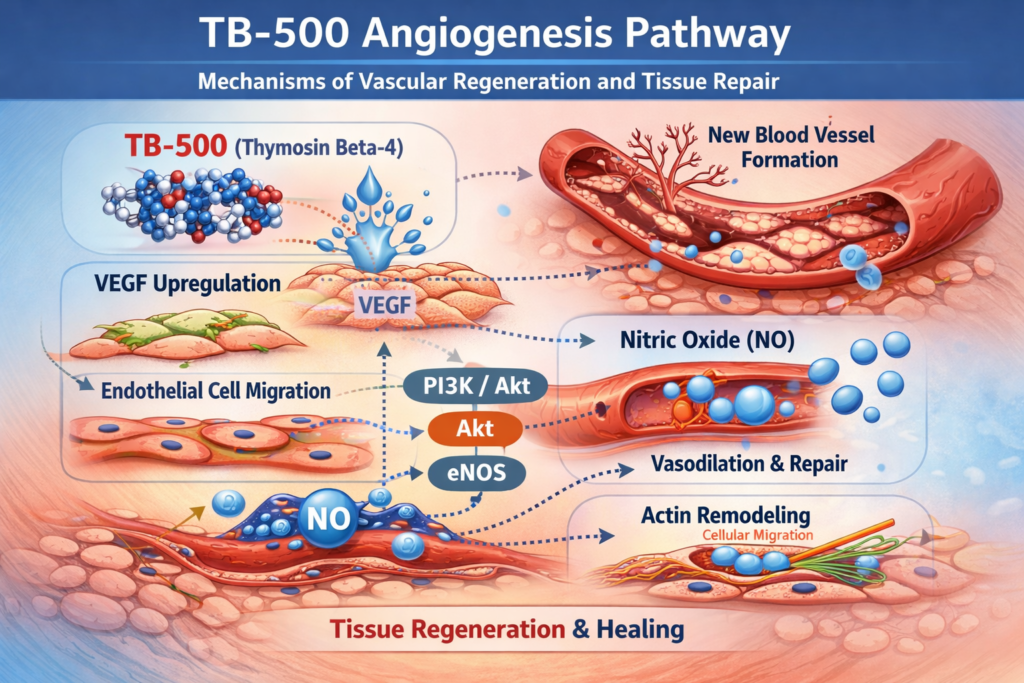
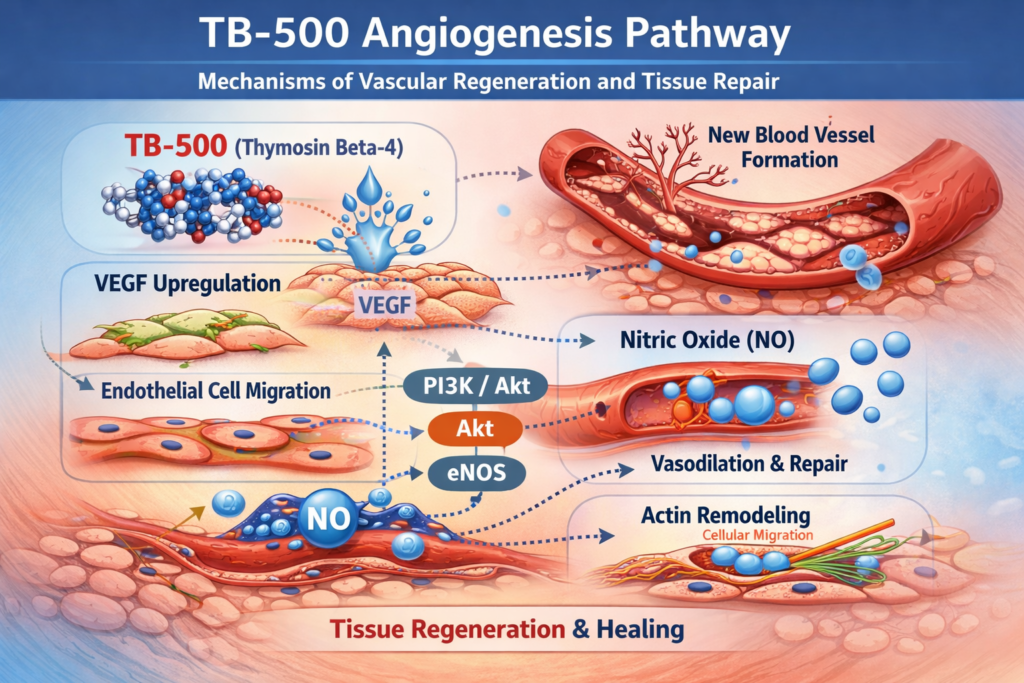
This appears to occur through the upregulation of Vascular Endothelial Growth Factor (VEGF) expression — one of the primary regulators of vascular growth.
Research has shown:
“Tβ4 significantly increased angiogenesis… evidenced by increased expression of VEGF”
VEGF plays a central role in:
- Endothelial cell differentiation
- Capillary permeability
- Vascular sprouting
- Neovascularisation
- Tissue perfusion
When VEGF binds to VEGFR-2 receptors on endothelial cells, it initiates intracellular kinase signalling cascades that stimulate:
- Cellular proliferation
- Migration
- Matrix remodelling
- Vessel maturation
This VEGF-dependent mechanism may explain why TB-500 angiogenesis research has been studied in models of:
- Ischaemic myocardial repair
- Musculoskeletal trauma
- Tendon injury
- Diabetic wound healing
PI3K / Akt / eNOS Signalling Cascade
Another major angiogenic mechanism associated with TB-500 angiogenesis research activity is activation of the:
PI3K → Akt → eNOS Pathway
This intracellular pathway is widely recognised as a critical regulator of:
- Microvascular angiogenesis
- Cell survival
- Stem cell recruitment
- Nitric oxide synthesis
Scientific literature indicates:
“Exogenous Tβ4 stimulates EPC proliferation, migration and adhesion via the PI3K/Akt/eNOS signal transduction pathway.”
Activation of Akt leads to phosphorylation of:
Endothelial Nitric Oxide Synthase (eNOS)
Which increases production of:
Nitric Oxide (NO)
Nitric oxide is a key signalling molecule that:
- Promotes vasodilation
- Increases vascular permeability
- Mobilises progenitor cells
- Enhances endothelial repair
Experimental knockdown of Akt or eNOS has been shown to reduce VEGF secretion and angiogenic activity — suggesting this pathway is essential for Tβ4-mediated vascular regeneration and one of the best peptides for recovery.
Cytoskeletal Remodelling and Endothelial Migration
Unlike many growth-factor-based peptides, TB-500 influences angiogenesis at the cytoskeletal level through its:
Actin-Sequestering Properties
Thymosin Beta-4 binds directly to G-actin, preventing polymerisation into F-actin, thereby:
- Increasing cellular mobility
- Enhancing adhesion dynamics
- Promoting endothelial migration
This allows endothelial cells to:
✔ Move toward hypoxic tissue
✔ Initiate vascular sprouting
✔ Form capillary-like structures
Scientific evidence confirms that TB-4:
“Promotes angiogenesis by stimulating differentiation of umbilical vein endothelial cells and migration of other endothelial cells.”
This migration-dependent angiogenic response is critical in:
- Tendon remodelling
- Muscle regeneration
- Ligament repair
- Cardiac tissue recovery
Additional Angiogenic Pathways Influenced by TB-500
During tissue repair and regeneration, Thymosin Beta-4 has also been shown to interact with:
Research indicates that TB-500 Angiogenesis can significantly impact recovery and regeneration processes, especially when bpc157 and tb500 are used together.
- Notch signalling
- Angiopoietin-1 / Tie-2 pathway
- NF-κB inflammatory cascade
- TGF-β fibrosis pathway
- Wnt regenerative signalling
Further studies on TB-500 Angiogenesis may provide valuable insights into its mechanisms and benefits.
Together, these pathways contribute to:
- Reduced apoptosis
- Increased cell viability
- Decreased inflammatory cytokine release
- Enhanced vascular density
Tβ4 may therefore influence angiogenesis through multiple redundant biological systems involved in structural repair and extracellular matrix remodelling.
Summary: TB-500 and Vascular Regeneration
Current preclinical literature suggests that TB-500 may promote angiogenesis through:
- VEGF upregulation
- PI3K/Akt/eNOS activation
- Nitric oxide production
- Endothelial progenitor mobilisation
- Cytoskeletal actin modulation
- Endothelial cell migration
These mechanisms are believed to support collectively:
✔ Microvascular regeneration
✔ Hypoxic tissue repair
✔ Accelerated wound healing
✔ Musculoskeletal recovery
For further information regarding TB-500 research applications and vascular regeneration pathways, please refer to our dedicated TB-500 research compound page.
References
- https://pubmed.ncbi.nlm.nih.gov/29956769/
- https://pmc.ncbi.nlm.nih.gov/articles/PMC8724243/
- https://pmc.ncbi.nlm.nih.gov/articles/PMC4733779/
- https://www.spandidos-publications.com/10.3892/mmr.2018.9199
- https://pubmed.ncbi.nlm.nih.gov/15037013/
- https://pmc.ncbi.nlm.nih.gov/articles/PMC6143828/
Exploring the role of TB-500 Angiogenesis in cellular processes is essential for future therapeutic advancements.
TB-500 Angiogenesis offers promising avenues for enhancing tissue repair mechanisms.