
Introduction
In recent years, the understanding of incretin-based therapies has dramatically evolved, leading to significant advancements in the treatment of metabolic disorders. These therapies leverage the body’s natural hormones to regulate blood sugar levels and improve metabolic health. This introductory section sets the stage for a deeper exploration of two such innovative compounds: Retatrutide vs Tirzepatide research, particularly in the context of retatrutide vs tirzepatide.
Retatrutide, a novel triple incretin receptor agonist, and Tirzepatide, a dual receptor agonist, are at the forefront of this research. Their unique mechanisms offer promising insights into how we can better manage conditions like Type 2 diabetes and obesity, which are becoming increasingly prevalent in modern society. This article provides a detailed comparison of retatrutide vs tirzepatide.
Both compounds not only aim to enhance insulin secretion but also seek to modulate other critical metabolic pathways, showcasing a comprehensive approach to treatment. The implications of these advancements could potentially transform patient outcomes and establish new standards in metabolic care.
As our understanding deepens, it is clear that the distinctions between Retatrutide vs Tirzepatide research will play a pivotal role in tailoring therapies for individual patients, ensuring more personalised and effective treatment strategies. This comparison not only highlights their differences but also underscores the importance of continued research in this evolving field, especially regarding retatrutide vs tirzepatide.
Retatrutide and Tirzepatide are both incretin-based peptide compounds currently being investigated in laboratory environments for their roles in metabolic regulation and energy homeostasis. As next-generation receptor agonists, both peptides have gained attention in metabolic pathway research examining glucose metabolism, lipid utilisation, and hormonal signalling cascades. This article also compares retatrutide vs tirzepatide, highlighting their unique attributes and the implications of their differences in therapeutic contexts.
The mechanism of action for these compounds is complex, involving various physiological processes that regulate appetite, insulin sensitivity, and energy expenditure. By delving into these mechanisms, we can better appreciate the therapeutic potential of retatrutide and tirzepatide in managing metabolic disorders.
In clinical trials, the specificity of receptor targeting has revealed distinct metabolic profiles for each compound. For instance, the dual action of Tirzepatide not only enhances glucose-dependent insulin release but also affects satiety and gastric motility, making it a comprehensive choice for managing blood sugar levels.
This article explores the mechanistic differences between these two compounds in a controlled research context, including receptor activity, intracellular signalling pathways, and potential applications in metabolic research models.
Understanding the differences in their mechanisms is crucial for future therapies, particularly in the context of Retatrutide vs Tirzepatide research, which may redefine treatment approaches in metabolic disorders.
Conversely, the triple receptor activity of Retatrutide allows for unique interactions within metabolic pathways. By engaging glucagon receptors, Retatrutide may influence hepatic glucose output, potentially leading to decreased liver glucose production and improved overall metabolic health.
Mechanism of Action: Retatrutide vs Tirzepatide
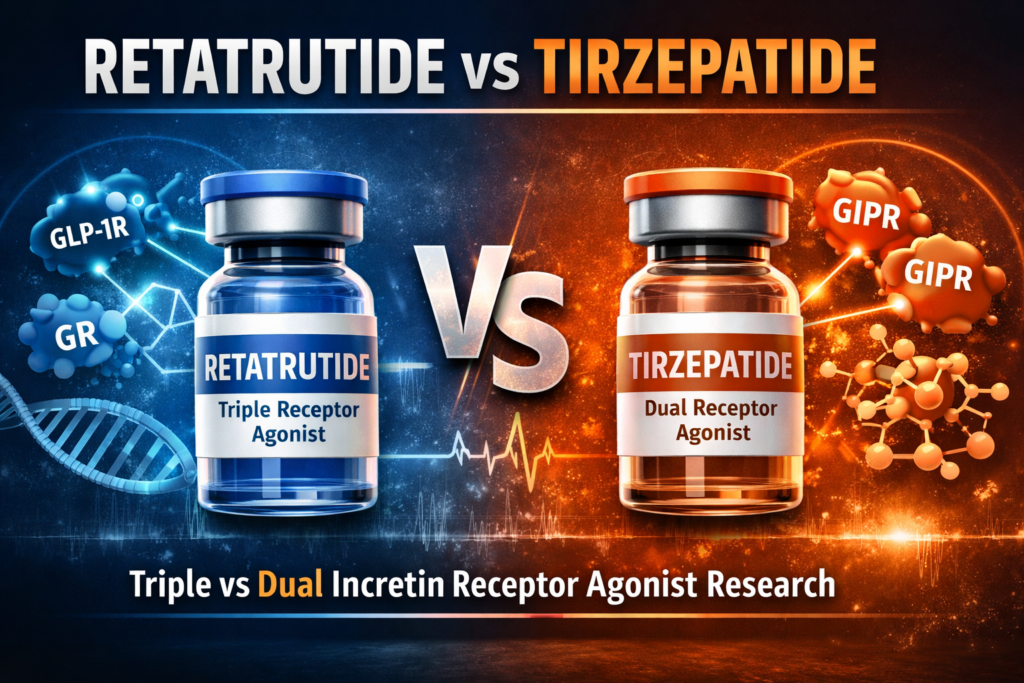
Tirzepatide functions as a dual incretin receptor agonist, targeting both the:
- Glucose-dependent insulinotropic polypeptide (GIP) receptor
- Glucagon-like peptide-1 (GLP-1) receptor
This dual receptor activity has made Tirzepatide a widely studied compound in insulin sensitivity pathway research and glucose uptake research studies within metabolic laboratory environments.
Retatrutide, by contrast, is a triple hormone receptor agonist, interacting with:
- GLP-1 receptors
- GIP receptors
- Glucagon receptors
This additional glucagon receptor activity allows Retatrutide to be explored in lipid metabolism research and cellular energy regulation peptide models beyond the scope of dual agonist compounds.
Moreover, the implications of these differences extend beyond glucose regulation alone. Studies suggest that Retatrutide’s action on glucagon receptors could facilitate enhanced lipid oxidation, providing insights into how these compounds might be leveraged for weight management as well.
As we consider receptor activity further, it is essential to note that both compounds are undergoing rigorous testing in preclinical studies. Researchers are keenly observing the effects of GLP-1 and GIP receptor activation, as these have significant implications for insulin sensitivity and overall metabolic health.
This research not only illuminates the unique features of Retatrutide vs Tirzepatide research but also highlights the broader context of incretin-based therapies and their evolving role in metabolic research.
Receptor Activity in Metabolic Research
In preclinical studies, GLP-1 receptor activation has been associated with enhanced insulin secretion and delayed gastric emptying in experimental models. GIP receptor activity is commonly investigated for its influence on nutrient partitioning and metabolic efficiency.
The inclusion of glucagon receptor agonism in Retatrutide allows for simultaneous investigation into:
- Hepatic glucose output
- Fatty acid oxidation pathways
- Energy expenditure signalling
This makes Retatrutide 10MG Research Peptide a potential candidate for multi-receptor metabolic pathway research peptide applications in laboratory environments studying adaptive metabolic responses.
Intracellular Signalling & Energy Homeostasis
Both Retatrutide and Tirzepatide have been investigated in AMPK-related signalling research, particularly in models examining mitochondrial efficiency and intracellular energy regulation.
However, triple agonist compounds such as Retatrutide may provide additional insight into:
- Mitochondrial substrate utilisation
- Lipid oxidation mechanisms
- Hormonal cross-talk between incretin pathways
These areas are of growing interest in metabolic flexibility research and broader investigations into cellular energy balance.
Given the complexities of metabolic diseases, understanding the interplay between these receptors is crucial. The focus on mitochondrial efficiency and energy regulation is especially pertinent as we seek to address the rising tide of obesity and related disorders.
Laboratory Research Applications
Emerging studies indicate that Retatrutide may influence mitochondrial substrate utilisation to a greater degree than Tirzepatide, potentially offering unique therapeutic avenues within metabolic flexibility research.
Notably, the applications of these incretin-based compounds are not limited to glucose metabolism. They are also being explored in the context of hormonal signalling pathways, which could provide new insights into how we approach treatment for a variety of metabolic conditions.
Current experimental applications for incretin-based peptide compounds include:
- Metabolic homeostasis research
- Glucose transport pathway studies
- Lipid metabolism modelling
- Hormonal signalling pathway investigations
- Energy expenditure research
As a triple agonist peptide, Retatrutide may offer expanded research potential in studies where dual incretin receptor activity alone is insufficient for modelling complex metabolic interactions.
As metabolic research progresses, the potential of Retatrutide as a multi-receptor research peptide suggests that it may be pivotal in uncovering new mechanisms related to energy expenditure and metabolic homeostasis.
Conclusion
While Tirzepatide remains a well-studied dual incretin receptor agonist in laboratory settings, Retatrutide’s additional glucagon receptor activity presents new opportunities for metabolic regulation research and intracellular energy pathway investigations.
Ongoing research continues to evaluate the mechanistic differences between dual and triple receptor agonists in experimental environments focused on metabolic efficiency, mitochondrial function, and hormonal pathway modulation.
In conclusion, as we navigate the complexities of metabolic disorders, the comparison between retatrutide and tirzepatide illuminates the path forward in therapeutic innovation. With continued research and exploration, these compounds are set to redefine our understanding of metabolic regulation in clinical practice.
Ultimately, the focus on the mechanistic distinctions and potential applications of both Retatrutide vs Tirzepatide research will play a crucial role in shaping future treatment paradigms for metabolic disorders, paving the way for more effective patient management and improved health outcomes.
As research continues to evolve, the comprehensive understanding of retatrutide vs tirzepatide will remain essential for healthcare providers and researchers alike, ensuring that the latest therapeutic advancements are translated into clinical practice for the benefit of patients.